The “fundamental question of our time”
 I read a wearisome headline this morning. It was from one of those curious “speech-preview” press releases. Apparently Donald Trump will today say that the “fundamental question of our time is whether the West has the will to survive”.
He, and whatever advisors wrote this statesmanlike pretension for him, is wrong.
The fundamental question of our time is how humanity can come of age. For example by transcending its adolescent preoccupation with nationality and race. Or by recognising the damage done by inequality and the fact that inequality is more and more unnecessary as technology develops.
The fundamental question of our time is about when and how we are going to recognise that there is just one humanity and that we are all, in essence and foundation, the same. [What is different, and gives richness to human life, is how we then play out, and are allowed to play out, the sequence of events that our personal common humanity encounters].
When we can do that, other issues such as climate change and pollution, become much more straightforward. Because when there is just one humanity, we recognise that we all share one common home, one common legacy. When there are no ‘other people’ to blame, we have no reason, no choice, but to get on with cleaning up and protecting our common future.
One great challenge to come from this, at least temporarily, might be accepting that many of us need to have a little less and be a little more. So what do we say to those who most feel the need to ‘have’ – to own stuff and have power? These people who talk about, “whether the West has the will to survive”.
Mastery
I am very struck by the Japanese concept of Shu-Ha-Ri
This is the description of a way, which leads to mastery of a skill, or of a perspective… of life.
Shu. Learn: Follow the rules
Ha. Break Away: Let go of the rules
Ri. Transcend: There are no rules – all is natural
I can see, almost feel, how this applies to mindfulness. That may be experientially within a single practice, or in one’s approach to practicing, or in the application of mindfulness to work and life.
For a long time, within a mindfulness practice, the question might be ‘… did I transcend, or did I simply fall into dullness of mind and sleep?’ :0)
At some point today, reflect on the activity you are engaged in at that moment, and ask yourself how Shu-Ha-Ri may apply to the way you are doing it right now… or to how you might choose to do it in the future.
I will do the same.
 I am running the next five week introductory Mindfulness course for friends and community in Dartford during June and July.
.
Mindfulness at Work have again very kindly agreed for me to use the ‘Mindfulness is Now’ [MiN] course, normally run for business clients, at a fraction of the usual price. Only 30 places are available. The main details are below – followed by some explanation about what Mindfulness is and how it works.
..
.
.
Dates and Times:
.
Thursday 15th June at 7:30pm, then each of the following four Thursdays at the same time [June 22nd and 29th, July 6th and 13th]. Sessions start at 7:30 sharp, so please arrive in good time, particularly on the first evening.
.
Location:
.
Holy Trinity Church Hall, High Street, Dartford. DA1 1DE. Access is via the cafe a few yards to the left of the main church doors.
.
Cost:
.
£60 for the whole of the five week course including sessions, printed notes, audio downloads and e-mail ‘daily prompts’.
.
[16-18 yr olds – £20. Returning participants from previous courses wanting a refresher – £20]
.
.
.
How to sign up:
.
Please e-mail me on nick[at]soshall.net or call/text me on 07958 516967 to reserve a place. Similarly, please get in touch if you want to find out more about me or the course. You can just turn up on the first night – but advance booking ensures you won’t miss out, and that I know how many packs to prepare.
.
I can take payment at, or immediately after, the first session – by cash, cheque [payable to SoShall Consulting Ltd] or I can give you bank details for internet payment.
.
The course is not open to under-16s. Please also consult with your GP or other professional, before taking the course, if you are currently receiving help with a condition such as depression or anxiety.
.
.
.
What is Mindfulness?
.
Mindfulness is a way of approaching life, and in particular a set of regularly practiced techniques, which helps you to pay attention right now, without judging, to things as they are happening and as they actually are. This is an antidote to constantly mulling over what has happened in the past, or worrying about what might happen in the future. It reduces our tendency to obsess about whether we are doing well, doing the right thing, look OK to other people or deserve to be happy. By making us aware of how our thoughts and actions can just bundle us through the day on a kind of ‘auto-pilot’, Mindfulness allows us to pause more often and make conscious decisions rather than just reacting.
.
The result is reduced stress, better focus on one thing at a time, a clearer mind and better interaction with other people. This in turn can also improve your physical health, by reducing the damage that stress can do to our heart, circulatory system, immune system and digestion. More generally, it can help you to be happier and to appreciate more of life’s minutes – rather than just fast forwarding to the next ‘good bit’.
.
NICE [the NHS’s National Institute for Health and Clinical Excellence] has recommended a particular clinical version of Mindfulness training [called MBCT] for addressing depression in people who are currently well but have experienced three or more previous episodes of depression.
.
A good description of Mindfulness can be found on the Frantic World Website. The authors Danny Penman and Mark Williams have had a leading role in developing Mindfulness in the UK, and I will tell you more about their books on the course. But here’s what they say about Mindfulness.
.
.
.
So is this just a Work thing?
.
No. Mindfulness at Work are normally commissioned by employers to deliver the MiN course in the workplace – it has even won an award from the UK legal profession. The course pack reflects this workplace setting. But Mindfulness is applicable to all aspects of life, and to everyone. We always adapt the course for each audience – anyone can learn and practice these techniques, for a few minutes a day, and feel the benefit.
.
.
.
What happens on the course?
.
The course is informal, welcoming and fun – but also purposeful. The sessions are made up of Explanation, Experience and Enquiry. I will explain what Mindfulness is, how it works, how to do practices, and how to apply Mindfulness to everyday life. I will also point you to other resources and activities you can use to keep going after the course finishes – because the purpose of the course is to help you start a habit that you can benefit from for the rest of your life. You will Experience guided practices – typically 10 minutes – as I talk you though placing your attention on your breathing, or moving your attention around your body, and there are also other exercises to help demonstrate why Mindfulness helps. Enquiry is about reflecting, and discussing, together what you experience during a practice and how your week has gone between sessions. This helps to reinforce your learning, and to encourage others, or be encouraged by them through sharing. Knowing that “it’s not just me” can be a big help!
.
You will be shown how to download audio tracks, which you can use on a mobile phone/tablet, PC or Mac, to do your practices during the week by listening to a trainer’s voice. You will also sign up for daily e-mail prompts which explain some of the applications of Mindfulness and suggest things you might try, if you are in the mood, some time that day.
.
There is a printed course pack which summarises the sessions, points you to other resources and suggests ways of continuing the Mindfulness habit.
.
.
.
Is this a religious thing?
.
Mindfulness practices are very similar to some kinds of meditation. The techniques can be found in many different religions around the world, particularly Buddhism, which seem to have evolved similar approaches to dealing with life. When modern Mindfulness was developed in the 1970s and 1980s it was deliberately made more secular, so that belonging to a particular religion, or indeed aversion to any religion, should not be a barrier to taking it up. Mindfulness is compatible with many religious principles – not least compassion towards others and towards yourself! That second one is something many of us forget to have.
.
.
.
Other details:
. can give people other information when they sign up but, just in case.
There is parking nearby in the Market Place (by Iceland), Market Street (alongside the park), Overy Street, Acacia Hall (gates close 9pm) and Darenth Road. Many of these are free after 6:30pm. Parking by Aldi, at the Orchards, is free but only for 1.5 hours – which may be cutting things a bit fine. You don’t want to be worrying about getting back to your car throughout the session.
.
.
Any suggestions or questions please contact me via the methods given above.
Is mindfulness about eliminating our emotions?

Credit where it’s due. (The Traces 2)

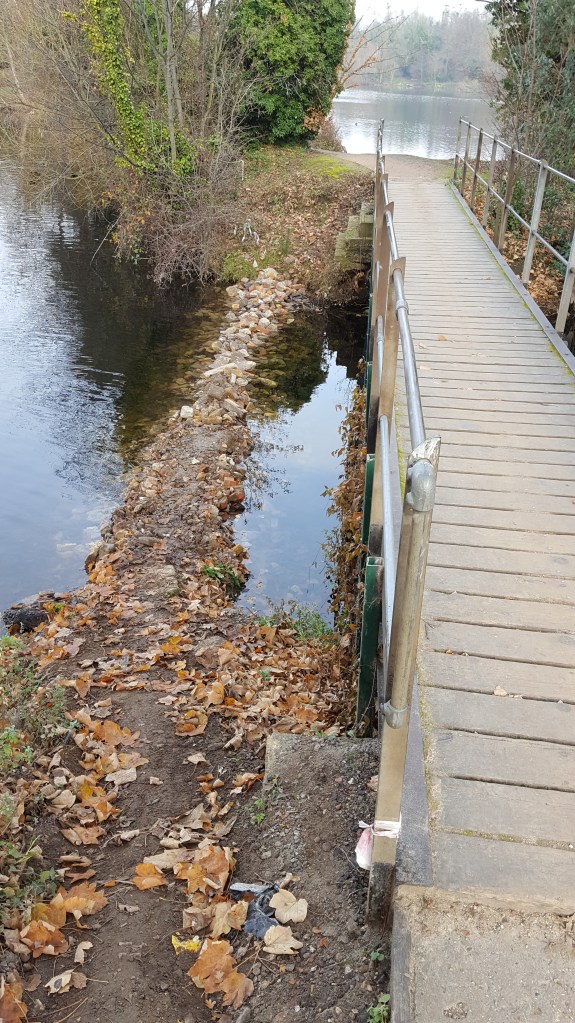
A couple of weeks ago I noticed that there were now warning signs in the area I had posted about at the beginning of December. This suggests that the Borough Council had now identified it as a hotspot.
Even better, someone, again I assume the Borough Council, had gone down and cleared up all the major rubbish from the road, footpath and turning space. Great work! And it would be good to know which agency to give credit to.
There’s still a horrific amount of rubbish on the land and cut-through between Powdermill Lane, the lake and Walnut Tree Avenue. But I assume this is strictly private land, with the scrubland awaiting development.
Despite all that, someone had still come down later and added a bit of mini-tipping, plus brushwood, in the turning space. Maybe they did a gardening job, had a packed lunch then took toys home for the kids but, poignantly, decided to skip the daffodils ?!
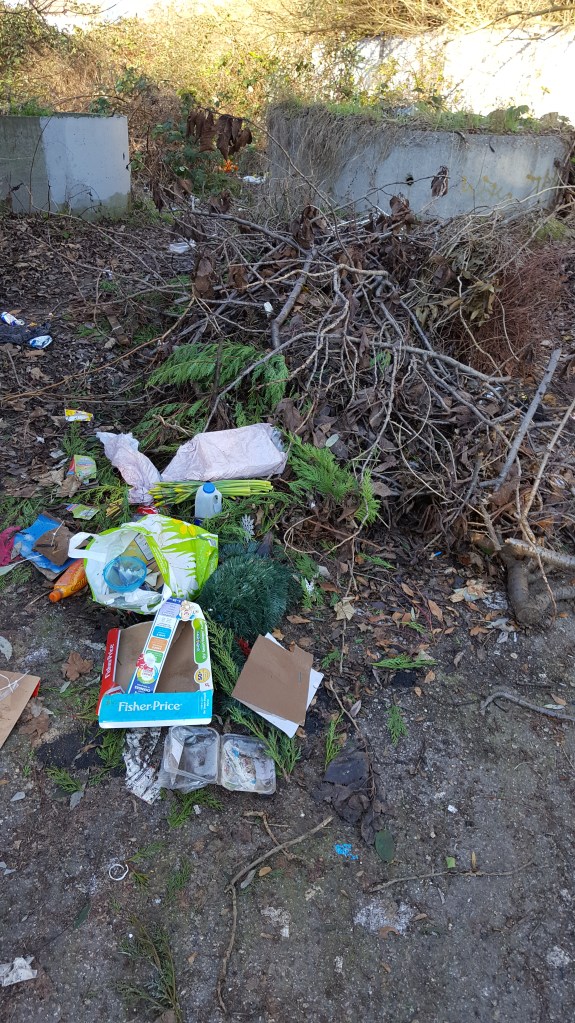
Probably not of great interest to my friends outside the Dartford area. But I have two general morals to draw. It can soon become disheartening if you see an area you use being regularly treated as a tip. Even if it is a fairly prosaic space, rather than the adjacent beauty spot. But it is also heartening when the local agencies that represent you make an effort to fight back, despite the fact that it may feel like an uphill struggle.
The Traces that we leave behind us






Mindfulness course for Dartford. Starts 7:30pm, Tuesday 17th January
I am running the next five week Mindfulness course for friends and community in Dartford during January and February.
.
Mindfulness at Work have again very kindly agreed for me to use the ‘Mindfulness is Now’ [MiN] course, normally run for business clients, at a fraction of the usual price. Only 30 places are available. The main details are below – followed by some explanation about what Mindfulness is and how it works.
.
Dates and Times:
.
Tuesday 17th January at 7:30pm, then each of the following four Tuesdays at the same time [January 24th and 31st, and February 7th and 14th]. Sessions start at 7:30 sharp, so please arrive in good time, particularly on the first evening.
.
Location:
.
Holy Trinity Church Hall, High Street, Dartford. DA1 1DE. Access is via the cafe a few yards to the left of the main church doors.
.
Cost:
.
£60 for the whole of the five week course including sessions, printed notes, audio downloads and e-mail ‘daily prompts’.
.
[16-18 yr olds – £20. Returning participants from previous courses wanting a refresher – £20]
.
.
.
How to sign up:
.
Please e-mail me on nick[at]soshall.net or call/text me on 07958 516967 to reserve a place. Similarly, please get in touch if you want to find out more about me or the course. You can just turn up on the first night – but advance booking ensures you won’t miss out, and that I know how many packs to prepare.
.
I can take payment at, or immediately after, the first session – by cash, cheque [payable to SoShall Consulting Ltd] or I can give you bank details for internet payment.
.
The course is not open to under-16s. Please also consult with your GP or other professional, before taking the course, if you are currently receiving help with a condition such as depression or anxiety.
.
.
.
What is Mindfulness?
.
Mindfulness is a way of approaching life, and in particular a set of regularly practiced techniques, which helps you to pay attention right now, without judging, to things as they are happening and as they actually are. This is an antidote to constantly mulling over what has happened in the past, or worrying about what might happen in the future. It reduces our tendency to obsess about whether we are doing well, doing the right thing, look OK to other people or deserve to be happy. By making us aware of how our thoughts and actions can just bundle us through the day on a kind of ‘auto-pilot’, Mindfulness allows us to pause more often and make conscious decisions rather than just reacting.
.
The result is reduced stress, better focus on one thing at a time, a clearer mind and better interaction with other people. This in turn can also improve your physical health, by reducing the damage that stress can do to our heart, circulatory system, immune system and digestion. More generally, it can help you to be happier and to appreciate more of life’s minutes – rather than just fast forwarding to the next ‘good bit’.
.
NICE [the NHS’s National Institute for Health and Clinical Excellence] has recommended a particular clinical version of Mindfulness training [called MBCT] for addressing depression in people who are currently well but have experienced three or more previous episodes of depression.
.
A good description of Mindfulness can be found on the Frantic World Website. The authors Danny Penman and Mark Williams have had a leading role in developing Mindfulness in the UK, and I will tell you more about their books on the course. But here’s what they say about Mindfulness.
.
.
.
So is this just a Work thing?
.
No. Mindfulness at Work are normally commissioned by employers to deliver the MiN course in the workplace – it has even won an award from the UK legal profession. The course pack reflects this workplace setting. But Mindfulness is applicable to all aspects of life, and to everyone. We always adapt the course for each audience – anyone can learn and practice these techniques, for a few minutes a day, and feel the benefit.
.
.
.
What happens on the course?
.
The course is informal, welcoming and fun – but also purposeful. The sessions are made up of Explanation, Experience and Enquiry. I will explain what Mindfulness is, how it works, how to do practices, and how to apply Mindfulness to everyday life. I will also point you to other resources and activities you can use to keep going after the course finishes – because the purpose of the course is to help you start a habit that you can benefit from for the rest of your life. You will Experience guided practices – typically 10 minutes – as I talk you though placing your attention on your breathing, or moving your attention around your body, and there are also other exercises to help demonstrate why Mindfulness helps. Enquiry is about reflecting, and discussing, together what you experience during a practice and how your week has gone between sessions. This helps to reinforce your learning, and to encourage others, or be encouraged by them through sharing. Knowing that “it’s not just me” can be a big help!
.
You will be shown how to download audio tracks, which you can use on a mobile phone/tablet, PC or Mac, to do your practices during the week by listening to a trainer’s voice. You will also sign up for daily e-mail prompts which explain some of the applications of Mindfulness and suggest things you might try, if you are in the mood, some time that day.
.
There is a printed course pack which summarises the sessions, points you to other resources and suggests ways of continuing the Mindfulness habit.
.
.
.
Is this a religious thing?
.
Mindfulness practices are very similar to some kinds of meditation. The techniques can be found in many different religions around the world, particularly Buddhism, which seem to have evolved similar approaches to dealing with life. When modern Mindfulness was developed in the 1970s and 1980s it was deliberately made more secular, so that belonging to a particular religion, or indeed aversion to any religion, should not be a barrier to taking it up. Mindfulness is compatible with many religious principles – not least compassion towards others and towards yourself! That second one is something many of us forget to have.
.
.
.
Other details:
.
I can give people other information when they sign up but, just in case.
.
There is parking nearby in the Market Place (by Iceland), Market Street (alongside the park), Overy Street, Acacia Hall and Darenth Road. Many of these are free after 6:30pm. Parking by Aldi, at the Orchards, is free but only for 1.5 hours – which may be cutting things a bit fine. You don’t want to be worrying about getting back to your car throughout the session.
.
.
Any suggestions or questions please contact me via the methods given above.
The REAL reason why we need the Arts in schools

.
IOIC Live 2016 (part 2)

* resilience, focus and balance
* the management of transitions between different tasks and different timescales
* openness to the experiences and perspectives of others and to new sources of information
* authenticity and ‘really knowing your own mind’, particularly when it comes to big decisions


 Nick Buckley : Practically Mindful