Sitting with Sounds
Mindfulness of Breathing
Taking a Pause
Building (in) our community
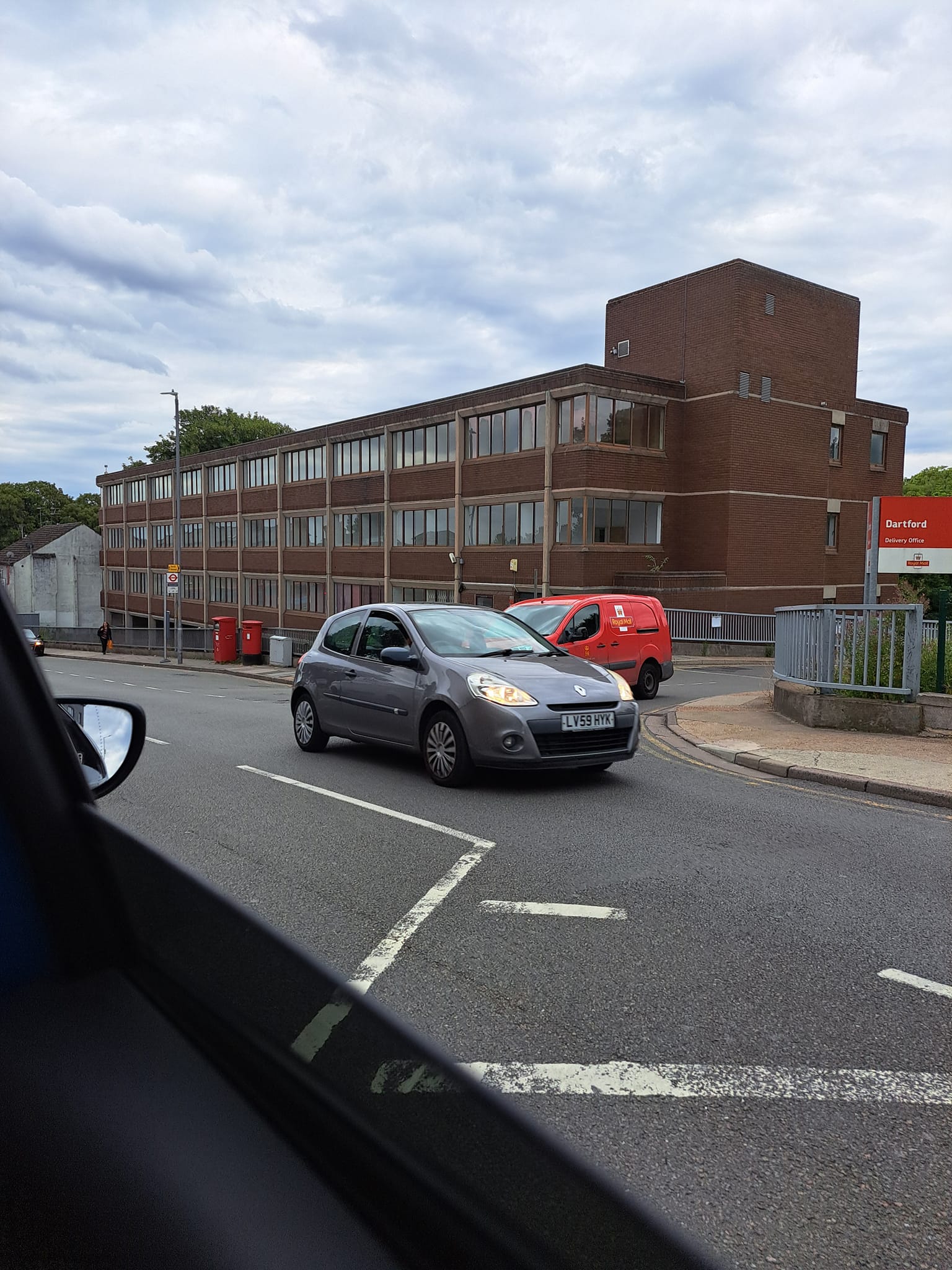
I do a lot of walking. Mainly for fitness and general health, often as an alternative form of meditation, and generally just to appreciate my environment. Much of the time I walk in the green spaces around my home town of Dartford (Kent), but sometimes I walk through the town itself, particularly if I have shopping to do, or I have an urgent appointment with the Growler Stop craft ale bar. Doing this regularly over the years I see cycles of seasonal change, but also longer-term trends. One of the things that nags away at me, and even depresses me a little at times, is the number of empty buildings. Not the classic ’empty shops’ issue, but other types of building, often formerly used for public services of some kind, and gradually deteriorating, gathering litter and weeds, and dragging down the look and feel of the town.
As I say, a nagging feeling… until today when I spotted a thread on the Dartford Living Community Facebook group. It asked who owned a particular empty office building on West Hill – and started with an image (see above) added by the original poster. The thread went on into a debate about how the building could be put to good use, and thence about immigration and priorities for support for different social groups. I knew it was previously a Kent County Council [KCC] office, and that it was briefly notorious after having been hijacked as a large cannabis farm! So I started to add a comment – about this, and about my nagging depression about once public buildings now adding to negative aspects of Dartford. My underlying thought was, “Surely this is, or was, our building! And yet we’re left with no influence or control over it now. What happened?
The comment grew and grew, out of many years worth of walking and brooding. Too big for a Facebook comment. So here, now with that context, it is:
” I’m interested in buildings like this. By ‘like this’ I mean things that were once publicly owned and were then disposed of in a way which has resulted in them standing empty, detracting from the appearance and life of the town, blocking positive activity, and creating the risk of crime, graffiti, criminal damage, fire etc, etc.
So, ‘like this’ would also refer to the main Post Office building in Hythe Street too. There may be others and perhaps other people who also know Dartford well, might suggest them.
These are buidlings that were once owned by a public body. This one in pictured in West Hill used to be owned by KCC. That means it was owned by us. When it was built it was funded by Council Tax payers’ money, or from central government funds which were designated for local government in Kent. So it was built by us, to serve our community. It was maintained by KCC. So it was maintained by us… and if it had become an eyesore or a risk at the time, we could have complained to our relevant Councillors about the state of our building, and expected a response.
At some point in local government cutbacks, I guess KCC decided they didn’t need it any more. They sold it off and, yes, the money they got for it probably went into the KCC coffers to, temporarily, ease the day to day budget. But when they sold off our asset, it looks like they didn’t put any conditions on the future development or use. For example, some kind of ‘use it or lose it’ clause. It is perfectly possible to put such covenants on land, or a property, as part of the contract of sale. But, given that it has lain dormant, collecting litter, weeds (and, yes, “weed”), suggests that it was just let go. Out of sight, out of mind. One can almost imagine KCC, headquartered in Maidstone, just dusting off their hands and turning their backs. We don’t have to look as far as Brussels for decisions being made, at a distance from our town, over which we have no say, but for which our town bears the consequences.
I’m sure a similar story could be told about the divestment of Royal Mail (Royal Mail Holdings, Post Office Ltd etc), the ‘arms-lengthing’ of that business, and then the inability of local bodies and representatives to prevent closure and sale of buildings, like the main Post Office in Hythe Street. This building is now contributing its own dilapidation and graffiti to the appearance of one of our town centre streets.
As I say, people may know of more such places in the Borough.
It’s one thing to argue about whether these buildings were surplus to requirements or capacity. But it’s another just to accept that the bodies disposing of them had no duty to our community, in determining their future state or use. It seems that organisations, some of which we can’t call to account, can just pocket the cash and walk away. In that respect, KCC, and Royal Mail Holdings (or whoever was ultimately determining the ownership and status of the Post Office) are no better than Tesco, who sat on the Lowfield Street land for so many years and turned the whole thing into an unproductive eyesore for a generation.
The cummulative effect of all these acts of neglect has a real impact on ‘What it’s like to live in Dartford’, or on whether people want to visit, shop, eat out, or open businesses to serve them.
Drew Swinerd [Note: a local Councillor in whose Ward the building sits, and who had helped out by doing some digging] helpfully answered some of the questions – i.e. that the West Hill building is currently owned by Central Park Capital Ltd and that it cost them £750,000. There’s maybe also the implication that, if anyone wants to put this to good use, they’re going to have to find £750,000 to buy it, and then they’ve inherited all the repair and running costs, taxes and utilities… before they can even think about how to fund whatever beneficial activity they have in mind. All good points.
Initially though, I’m interested in lower stakes than that. People often feel helpless today because authorities or businesses can make decisions which have an impact right on their doorstep, and they seemingly can’t do anything about it.
Either that’s not true, and there are powers that can be used, or at least should have been used when there was an opportunity. Or, maybe we should be looking for changes which give people more of a say in what happens to their neighbourhood. More than just voting for an MP, or a [District or County] Councillor.
For now – and I’m sticking just to this building and others with a public service history – I have some questions. I don’t know who can answer them, but maybe Drew, as a sitting Councillor can gives us a head start:
- What went wrong? What could KCC have done when this building was disposed of, to get a better future outcome for people living close to this building, and more generally for Dartford? e.g. by putting conditions on the sale of this public asset.
- If this could have been done but wasn’t? Why not? Who – collectively or individually – was responsible? Who, thereafter, were the original purchasers and what has the subsequent chain of ownership been.
- If nothing could have been done at the time, we have to shift to the present. Is there information, easily accessible, about the current owners’ plans for the building and property? In the absence of specific provisions in the contract of sale (to the original purchaser), what duties does the current owner have, anyway, to maintain the property, and the grounds, in a safe and secure state, and to mitigate the visual impact on the area? If there are such duties, who’s job is it to monitor and enforce them? If they are too busy… would they appreciate some help from people in the community to do this?
- Irrespective of whatever plans they have, are there general duties to do something with a property or land… or can someone simply sit on it, with impunity, indefinitly, no matter what state it is in… so long as bits of it don’t actually start to fall on people?
- At the end of that chain of thought. If there aren’t such duties, and there isn’t such transparency, does anyone agree that, as a strategy for the future of Dartford, such powers should be created? This isn’t without precedent – when special zones are created, such as to enable the creation of new communities like Ebbsfleet Valley, the development bodies are given the powers necessary to make the future vision happen.
Without the above – and, as I said, I’d multiply it by the number of similar buildings in the Borough – we all spend our lives in Dartford walking past disused buildings, ugly and wasted, with about as much ability to do anything about it as if they had been dropped from outer space. I hear, all the time, that people are frustrated bya similar feeling of helplessness about so many things. Is this a chance to start feeling, again, that the town is ours? And that the various Councils and public bodies are actually us, or at least our agents, in this respect, and not just more corporations?

I am finally leaving leaving the Labour Party – properly this time. I hardly expect that to send shockwaves through the local or national political system. But if I’m to try to find other ways of helping good things to happen in my community, it had better be clear why I left the Labour Party, and what this means about how I see politics and its relationship with local government, local governance and community involvement. In particular I want to be able to express opinions without these being judged, or summarily dismissed, as my ‘just saying that because you’re Labour’. Given that there’s nothing in the Labour Party for me, that would now be a double whammy!
This can sit on my blog somewhere and do that job. When someone says, didn’t you used to be in the Labour Party? … I can copy and paste this, or a link, into my response.
Why did I join the Labour Party in the first place? After all, I had pointedly abstained for many years, not least because of my experiences as a reasonably senior [“fast stream”] Civil Servant during the 80s and 90s, which included attending the House of Commons to support Minsiters in debates. My main issue with the two main political parties was that whilst, on the one hand, there seemed to be quite a narrow consensus about economically sustainable change, on the other hand there was an all consuming focus on the “other lot”… on what was wrong with them, and right about ‘us’. This is where all the energy went, almost dependant on the creation of difference, at the expense of attending to complex – and therefore potentially boring – analysis of problems and solutions.
Even more the questions arises, then… why did I join Labour?
About 25 years ago, as part of my work, I was lucky enough to meet and talk with Matthew Taylor [then the head of the Institute for Public Policy Research, now Chief Executive of the NHS Federation]. I was struck by his characterisation of UK politics, and also by the principles behind an alternative that the IPPR was exploring in practice. His take on politics was that politicians pretend that they have the answers to our big problems, we pretend to believe them, so we elect them, passing all the responsibility and burden on to them. They spend time with power, privileges and some degree of material reward… a bit like the old legends of a King for a Year. Finally, like said King or the Wicker Man, we scarifice them to purge our anger and frustration that the problems are still there. New politicians come along, pretending to have the answers… we pretend to believe them… and the cycle repeats.
The antidote, which was so striking that I have kept hold of it – and written about it since – is to see the taxes that we pay as a ‘Club subscription’ rather than a service charge. Rather than wash our hands of government “because we’ve paid our taxes”, leaving us free to be children to the politicians’ adult… blaming or thanking them… we’d retain a duty to help the club. We’d roll up our sleeves and take part in local governance and services, staying close to the politicians, whilst holding them to account for the things that they too are supposed to be delivering. In a Club, by analogy, you can hold the committee to account whilst, at the same time, helping out with decorating, or events or fund raising. I subsequently saw this thinking re-packaged, and distorted in some critical ways, in the form of David Cameron’s “Big Society”.
I know… I know… so why did I join Labour in 2016?
Two reasons. The party had had a huge influx of members. This was largely attributed to Jeremy Corbyn. But I wasn’t so much interested in Jeremy Corbyn – though I could see little about him that deserved the bogey man status he was given by the British media, and in particular I could see little about his policies that were different from many mainstream parties in the rest of Europe. I was less interested in Jeremy Corbyn than in that influx of new members. It looked to me as though, particularly on a local level, this created scope for a party that did things, on the ‘Club member of society’ model – whether in power or not. That’s because it would have the human resources to do so, in contrast to a previous small cadre of political activists. That’s also in contrast to being a tithe gatherer and electoral machine or, at best, a source of campaigns telling others what they should/shouldn’t be doing. I was curious, and excited, about the chance that the ‘Club’ model of local politics might actually happen on the ground. So I joined… to see inside. Yay!
My second reason was that there was a really nasty climate in 2016, post-Brexit, which smelled of xenophobia and right wing nationalism. I knew enough history not to be complacent that ‘it couldn’t happen here’, and I also knew that when extremism took power in the past, many normal decent people only realised when it was too late, and when it had become very dangerous to speak out or oppose the ruling regime. I felt that if it did become necessary to fight, in whatever sense of the word, it would be better to do this as part of an established organisation, with a history of opposing discrimination and oppression, than as an individual. So I joined… just in case.
[Important Note: My crtique of what then happened, below, intentionally conflates my experiences at constituency level, at regional level (personally and through my friends’ experience), and what I know about events elsewhere in the party, nationally. In part this is because I am taking pains not to level specific accusations against individuals – for example as a cheap parting shot. In part it is because there are probably some people who would want to ‘come after me’ if I were to do so, and I don’t have the time, energy, patience or money to deal with that. In any case, what I have chosen to leave, and what my issue is really with, is the whole of two party politics… not just its symptoms within a party or a branch. I am generalising on purpose, then, but not through a lack of first hand personal experience. I appreciate that others may see things differently. I’m not claiming that my view is absolute. But these are my expectations, my perceptions, my lived experience and therefore my reasons.The other thing I need to make absolutely clear is that there continue to be some great individuals in Dartford Labour Party, who care about their communities and work hard on their behalf. I regard some of them as friends. A good part of my overall point is that I don’t believe in lumping people together under a common set of assumptions.]
From my personal perspective, what actually happened was that Labour – including the local microcosm of Dartford – squandered that influx of new members. It missed the opportunity to become something that a large chunk of the population wanted to be part of… actively making things happen… in contrast to the kind of adversarial, name calling, politics that had turned them off for years. People like me then!
There was, of course, a split in the Labour Party at the time. A split between established members ‘on the right of the party’ and established members ‘on the left of the party’. The latter quickly became labelled as “the Hard Left”. Whilst these characterisations might have made some sense when applied to the core or ‘top’ of the party, it wasn’t something that many of us new members wanted to take sides on. Indeed, it was precisely the sort of intellectual, ideological, game that had kept many of us away. Yes, a lot of new members cited Jeremy Corbyn as a motivation. But often this was about a picture he had painted of how politics could work. Whether he was capable of delivering that, or whether those in his immediate circle always saw things the same way, is not the point. The point is that this was what many of those people had bought into. And they were Labour Party members, and every single one of them was just as individual and important, as those who had been members for years – including those who had previously enjoyed power and influence in local parties, and who were therefore close to the administrative machine and its rule book.
Many of these new members attended socials and meetings and made thir hopes and motivations clear. But there were also several hundred other new members within Dartford, for example, to whom I never saw any effective or sustained outreach. My working assumption, given the timing, is that those people had been attracted for similar reasons.
What did happen is that there was factional conflict at the heart/top of the party. There were those in local branches who reflected this. This included those who had previously enjoyed influence and status before the influx. On behalf of ‘real’ Labour, or Old New Labour, or whatever, they wanted to “take back our party”. I heard phrases like “It’s not their party, it’s ours!”, and so on. One way in which they approached this was to insert polarising debates and motions at a local level, often concerning issues that just weren’t manifested locally. These were designed to garner numbers around the proposition that the membership, country wide, didn’t support the national leader. Unsurprisingly, there was a reaction to this local manoeuvring, and many people (not least amongst the newer members) became upset, indignant and vocal about being manipulated into taking sides – on issues that weren’t central to their concerns. This was exploited as proof that they were all on the ‘other side’ and that their provoked unruliness confirmed they were all part of some sinister and threatening faction. In that respect, you could argue that the ‘Take our party back’ group was successful in creating a self-fulfilling prophecy.
For my part, I was so appalled at these narrow and blinkered tactics, at the failure to even explore the scope for consensus or synthesis, that I resolved to try to thwart the people behind them. So, clearly, I must be one of those sinister usurpers too, with a conveniently pre-defined set of views on everything else.
I should stress that I myself, for whatever reason, never suffered any direct attacks or accusations. But I was definitely, crudely, ‘lumped in’. That means I understand the feelings of many others who, having come to Labour with diverse and individual motives, were dismissed as part of a misguided anomaly, rather than consulted and integrated into a new party consensus.
Nowhere was this clearer than on party social media groups where – at a regional level – those who regarded themselves as stewards of the pre-influx party wisdom, wrote sneering pieces [and, yes, “sneering” is exactly the right word to describe the language and tone] about how naive new members were about “how to get elected”, and that they would one day realise just how stupid they had been. Anyone taking the sneerers to task, as I confess I lapsed into a couple of times, was told they needed to earn the right to comment by being “out on the doorsteps”. A prevalent patronising put-down was that “you can’t do anything if you’re not in power”. That’s something I will come back to in a moment. Again, I took offence not on my own behalf, but on that of so many people who were just being dismissed.
I think there’s something key in the ‘out on the doorsteps’ reprimand. As I have said, I think that previously there was a relatively small number of people, in each constituency party, who had the time, energy and obsessive focus to dominate the messaging and activities… to act as the unchallenged ‘voice of the party’. These people also seem to have had an appetite for the rule book and for procedures. I think that for them, a sudden influx of new local members, far from being a welcome injection of resources, energy, ideas and creativity… was just too much to cope with. All the new opinions and values and goals – often allied with assertiveness and confidence – had the potential to overwhelm those who liked to be in control. How convenient then, to dismiss them all as deluded lefty zealots, Corbyn fanboys and fangirls, from whom the party had to be taken back. What the party probably wanted, and wants now, is doorstep cannon fodder, and raffle ticket buyers… the early stage rockets to launch one or two chosen astronauts into electoral space. It’s inconvenient when the cannon fodder starts having diverse ideas and opinions.
And so it was that, over time, and no doubt all over the country, those who had previously enjoyed mastery of their local parties [and are probably better categorised by that than by their left- or right-ism] proceeded to ‘take back their party’. One of the tactics which upset me the most (and, again, I wasn’t subject to it myself) was the use of complaints to get members suspended, often for long and indeterminate periods of time, in order to remove them from internal ballots and from making themselves heard at meetings. Confidentiality, of course, meant that such people couldn’t know who their accusers were [because, also “of course”, they would have brutally intimidated them]. Nor were local members told which, or even how many, members had thus been taken out of play, or how many long suspensions actually culminated in formal expulsion before the subject simply gave up and walked away from a party that had treated them thus. Again, that’s just confidentiality, isn’t it? But it created a sinister atmosphere in which previously regular attenders simply disappeared from meetings. In Dartford, I wrote to my Executive Committee about this, seeking aggregate data, and never got a reply. This, and also the nullification of some decisions, elections and resolutions made within local parties, smacks of the ‘career’ members wielding the rule book, at the expense of those whose priority on joining a party hadn’t been to set about memorising Paragraph B, sub-paragraph C, point (ii). The point of a rule book is actually [and there are echoes of this in a Japanese attitude to contracts] to set out an agreed way of doing business when there exists the necessary cooperation and trust – it’s a tool for clarity and structure. At the point where the rule book is used, letter by letter, to gain an advantage over the other party, it has actually ceased to have a purpose… or it has even failed in its purpose.
One other thing which particularly upset me about this whole strategy, is the way in which it had no regard for the wellbeing, or diversity, of those against who it was directed. Not only that of those who were on ‘the other side’, or ‘the wrong side’ but also those on ‘the right side’ who were nonetheless distressed and exhausted by the acrimony and polarisation that was stirred up. I include in that, neurodiversty. This is an aspect of inclusion and equity which the Labour Party may be coming to terms with externally, and in policy, but which seemed to be sacrificed, internally, in this holy battle for the soul of the party. For me, the most striking feature of the whole, ‘take back our party’ campaign that I witnessed, was the absence of kindness. That is the antithesis of the Labour movement’s claim to champion compassion and equity.
That’s where, from my particular vantage point, I think the Labour party is now. A proportionally small number of people, for whom political influence, status and power is at the centre of their lives, have taken back their party… thus regaining that influence, status and power. They have applied, internally, a mindset which intentionally stoked up polarisation, and which they no doubt justified by the claim that ‘the other lot’ within the party were even worse. In doing so they have assigned a whole movement – the 2016 influx – to that ‘other side’, and thus disregarded, or suspended, or jettisoned – by neglect or active rejection – a huge resource that could have started to do things – whether ‘in power’ or not – as well as seeking election. Such is the state of politics, and the broad reputation of politicians, that I think a party which was seen to be directly working hand in hand with a much broader base of local people, might have made sweeping gains… not just (or not so much) on the part of a Party, but on the part of that whole model of politics.
Which brings me back to “you can’t do anything, if you’re not in power”. In a two party system, doesn’t that mean that for all the years that you are not in power, you focus all your effort on getting back in, and not on anything else? It requires focusing your effort on what those in power are doing wrong… which they must be doing wrong or you’re not going to get back into power. [This is indiscriminately passed off as “calling those in power to account”]. Does it mean focusing on contributing to the wellbeing of your community in any other way… except, perhaps, through campaigns about what else is wrong? We are back to the world that Matthew Taylor described, of the conspiracy of credibility between politicians and electorate, followed by the ulitmate, inevitable sacrifice of the King for a Year… so that the ‘the other lot’ can have their turn… thus paving the way for your turn… ad infinitum.
If you cleave to “you can’t do anything, if you’re not in power”, what principles do you uphold? How do you deal with unpopular principles you might hold? What behaviours do you have to countenance, to win power, in order to then do good? A simplification of this dilemma is, ‘If you say things you don’t really believe, in order to get into power, what do you then do? Do you enact those promises? Or do you renege on them?’. A few years ago I had a conversation like this with Keir Starmer. He came to visit Dartford Labour Party as part of a national tour he was doing, focused on immigration. I had no idea who he was, and neither did almost anyone else at the time. The conversation lasted all of 10 minutes, but I effectively put the above question to him, in the context of immigration policy. I asked him, if you were to promote certain immigration policies in order to get elected, using some kind of rhetoric around ‘recognising people’s genuine concerns’, but which were at odds with your own principles… what would you do when elected? Would you carry them through, at the expense of principle… or would you change tack on them, at the expense of honesty and truthfulness? Yes I only had 10 minutes… but I couldn’t get a definitive answer from him.
I’m leaving the Labour Party. I’m not leaving because it’s being run by the wrong people. I’m not leaving because I think things were done in my local party which I found unkind and unnecessarily, almost lazily, divisive. I don’t think that the people who did these things, all across the country, were inherently bad people. In fact, I suspect those people were behaving rationally, if you accept the two party system in its entirety. If you want to be an MP, and thus a Minister or holder of other high office, the system means that you really need to gain control, power and influence within your own party, such that the party then makes you a candidate in a winnable seat, where people will be voting for the party and not for you… or for your virtues or contributions. Once an MP, I’m sure it continues, and that the same rationale and in-fighting is needed to gain promotion within Westminster. All ultimately, you might say, to be in a position to do good things, and make the world better in accordance with your values. But, by then, are you in a fit state to do that? Or were you ever, if you are the sort of person who is actively attracted, in the first place, to this kind of power-garnering game.
I know that there are many good and selfless politicians. No, really, I’m sure there are and that this is not some kind of oxymoron. But I think they are thus in spite of the system, or have gained their ascent almost by accident. There must be nothing more galling for a candidate, than to see someone from the opposite party getting re-elected, at a time when that party is in the decline, because he or she is “a really good hard working consituency MP”, and/or because they “have done so much for local people”. But the system largely militates against establishing individual merit with the public.
I am certain that the Conservative Party must mirror all of the above, in every way, Because it, too, is a product of the same adversarial system, and a system where progress in office first requires progress (and hence control) within the party.
What I am leaving, then, is two party politics and all its consequences and dysfunctions. I’m leaving the game playing and wonkery and the personalities which these often seem to attract. I’m leaving the tactics and speechifying which seem at least two generations out of date.
It is accurate to lay much of what is going wrong in the UK at the door of the Conservative Party, or “this Government”, simply because they have been there for 13 years. But I think it would be more accurate to lay it at the door of the two party system, and the behaviours and priorities which this necessitates. Those behaviours and priorities act at the expense of the strategic thinking, open mindedness, compromise and down right boring problem solving, which are necessary to efficiently manage a country, or a planet… or a Borough.
What do I do now then? Doesn’t matter really, does it? There’s only one of me. I was never going to make that much of a difference, or to have the impact of a once-in-a-generation political giant like Liz Truss.
By which I mean it shouldn’t matter much to anyone else. I don’t expect you to be hanging on my next words. But it matters to me what I do next.
When faced with any huge intractable problem, I give myself the same advice that I give to others. What is in your circle of control, and what isn’t? What can you do, within that circle, which does some good, avoids doing harm, and which in some way, however small, addresses the problem? Then you will have done something, and it will make a difference, and you will feel better and less powerless.
Beyond that though… if, as a result, you connect with some other people trying to do something similar… and you help each other – that’s even better. And if your joint action attracts yet more others – great. And if, one day, you need to deal with people in political power, to get even more done… well, by then you’ve got a track record, and evidence, and proven commitment, on your side. And if that doesn’t work, and you think some of you should directly seek public office… do that. But you would be going to the polls on the basis of what you have done. Not on your affiliation to one of two long-established political leviathans. Not on the basis of what you have merely said, or promised without evidence.
This is what, between the advent of the Big Society and my joining Labour in 2016, drew me to things like the emerging Dartford Arts Network, and also, for a spell, to Dartford Big Local. I’m going to do more of ‘that stuff’… with the emphasis on doing. So I’d better stop writing in a minute. If you share my take on this, and if you believe in building consensus and action at a grass roots level, transcending parties, and with an emphasis on sustainability, compassion and equity… but above all on really really listening, without judgement, to other people… give me a shout.
Thinking back to my two reasons for joining Labour, seven years ago. Reason 1: My curiosity is satisfied. I was never naive about this, so many of my previous assumptions are now proven, but nontheless in a saddening way. Reason 2: I’m still concerned about the scope in the UK for xenophobia and right wing nationalism… but I don’t now see the Labour party as much of a help with this… particularly within the context of a two party, take your turn, system.
I’m leaving the Labour Party.
So long, and thanks for all the fish suppers!
No one argues with an empty boat

I was talking with some friends in a meditation practice group the other day about – it now occurs to me – the relationship between wisdom and blame. It was about whether our actions and reactions are ‘on us’ or ‘on other people’, and about what shapes our decisions about this in the heat of the moment… as opposed to later.
For me, the discussion brought up a memory of a phrase I read long ago, and have reflected on at intervals ever since. “No one argues with an empty boat”.
Later, I thought I should check the origin of the saying, and it turned out to be attributed to the Chinese, Taoist, philosopher Chuang Tzu.
My interpretation is something like this – and I try to weave into it a picture of a place where waterways are crowded with small boats carrying passengers and produce.
Imagine you are piloting your boat on the river, and another boat comes speeding into you with a violent crash. You are thrown sideways, you injure your arm [it hurts!], some of your precious cargo falls overboard and there’s now a crack in the hull of your boat.
But the other boat is empty! It appears to have broken its moorings during a storm earlier in the day.
You may be shocked, hurt, angry and frustrated. But there is nobody to shout at, abuse or blame. The only ways to improve the situation are to get on and fix yourself, fix your boat, and maybe hope that some of the lost cargo can be retrieved. You set about practically putting things right.
Rewind….
Now imagine exactly the same situation, the same impact, the same damage, the same shock and pain. But this time, there… sitting in the other boat… is a person.
The injury and damage is the same as before, so the real solutions to your problems are the same. The only difference is the presence, in that boat, of another person.
But in all likelihood, stoked by your shock and rush of adrenalin, all your focus is on that person – you shout at them, you abuse them for their stupidity and recklessness… you tell them all the things they were doing wrong.
At this stage, a thoughtful and pragmatic person might start to point out to me that the other person isn’t irrelevant. Maybe they need to take responsibility, gain some insight and change their future behaviour. Maybe you need them to help fix things, or at least pay up later.
I have two responses.
The first is that, even if this is the case, your instant fury and abuse [your ‘boat rage’’ if you like] isn’t going to help facilitate this, or to get clarity on why what just happened, happened. Helping the other person to take responsibility, learn, or offer redress, requires an entirely different dialogue.
My second response is that this is a saying, a metaphor or parable. The boat, including us as pilot, is our own person or self, the other boat plus pilot is another whole person. By asking us to consider how we might react to an empty boat, I think Chuang Tzu is suggesting that when other people have an impact on us, our focus should be on that impact, not on the interior self or ego that we attribute to the other person… in that moment. The wise thing to do, he is suggesting, is to focus on putting things right, not on putting the person right. It’s highly likely that the latter is impossible, unless you want to dedicate the rest of your life to the task!
Bringing this back to my own outlook on life, I think that putting things right, in such situations, is therefore also largely about managing our own responses. After all, that is something which we can own and control. Or if we can’t entirely control our reactions in the moment we can, through regular practice, shift the odds in favour of our reacting in a wiser way. Maybe, to stretch the metaphor a little, we may also change the way we pilot our boat, and keep a better lookout, or help ensure that others’ boats are well-moored.
Even then, I wonder if Chuang Tzu’s own invitation goes beyond this. What if – and again in metaphorical and slightly ambiguous terms – we were able to empty our own boat? If we were the empty boat, how would others react to us when we interacted with them? Might they, too, then focus on putting things right, rather than putting us right?
What does it mean, to empty your boat? I think it’s something about ego, and selflessness. But I’ll need to reflect and meditate on that for a while yet.
Simple Compassion Practice
Happy New Year!
Happy New Year!
This event is full of connotations and imagery about a ‘fresh start’. But it’s entirely arbitrary isn’t it? Any day could have been, or could be, New Year’s Day – no?
There’s a lot of cultural baggage though. In the northern hemisphere, where the dominant Gregorian calendar arose, the New Year is close to the shortest day of the year – the longest night – so it does mark the beginning of a journey back towards spring, summer, light, warmth and growth. In this respect, it’s pretty much the same landmark as Christmas. That’s probably why it’s been adopted as a time to discard the old, start new things and make resolutions.
The problem is that we often then use the New Year as a one-off prompt to take on something too big.
In particular, just knowing or deciding that it would be good, or good for us, to do x, y or z, is often not enough to sustain behaviour over the long term. We need to build habits, through gradual positive feeback, and we need to know how to do this. Otherwise ‘I should’ or ‘I will’ are going to run out of steam.
There are exceptions. You might know someone who embarked on a major New Year’s resolution which lead to a life-changing new behaviour or life choice. But the odds are that this ‘stuck’ because other circumstances were lined up favourably as well – support, opportunity, and the intensity of the reasons for change.
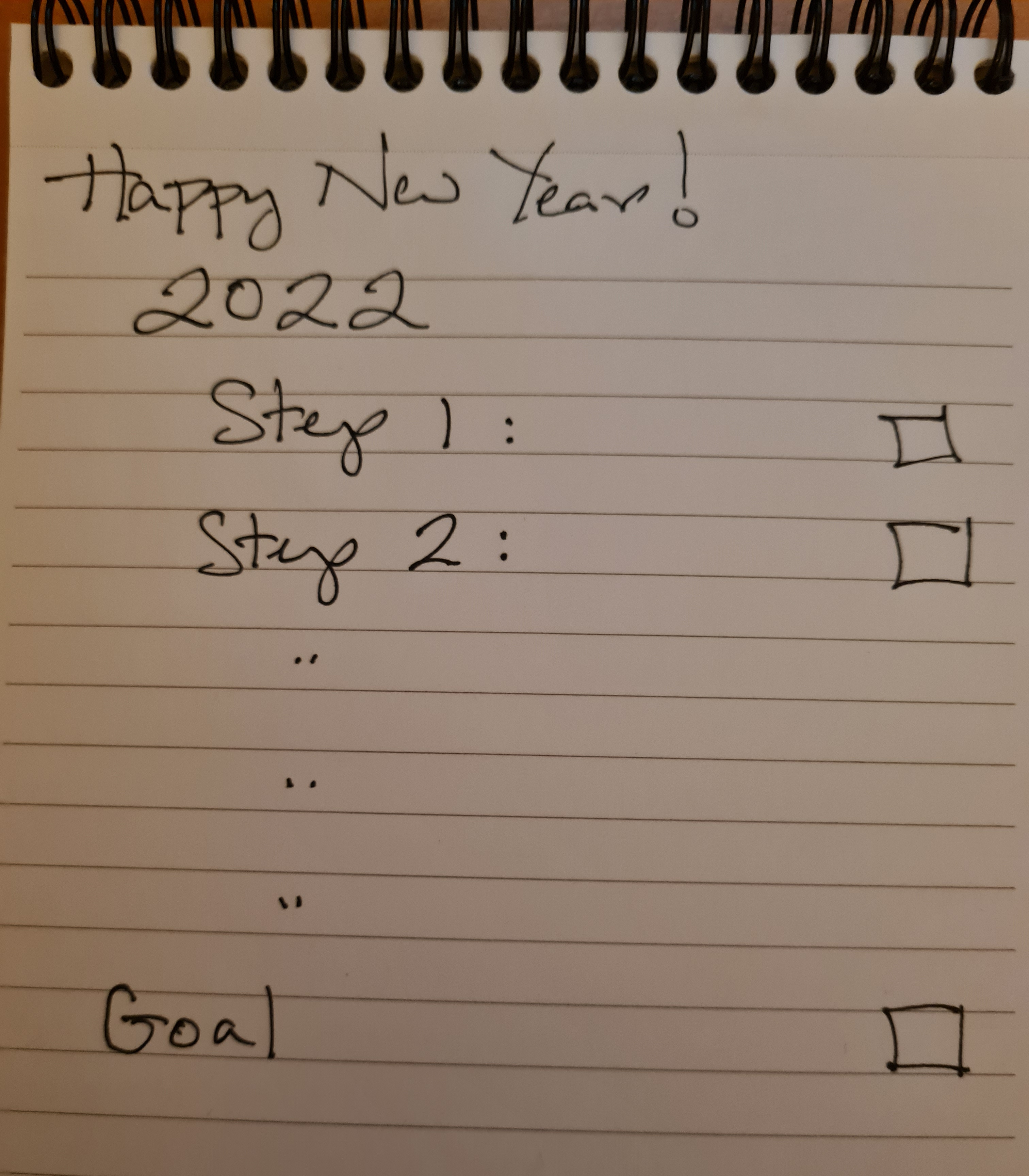
My own suggestion for the New Year is to identify something that is important to you, but which also looks really achievable in the short to medium term. Achieving that, however modest it is, will make you feel good and could set you on the path to a succession of similar achievable stepping stones leading to some much bigger goal.
As 2022 gets underway, quietly open your mind to what you would like to be different. Then see if you can also get some clarity on how much of this is within your own control. What else needs to happen, to make the change possible? Identify that first achievable step towards this change. What does an achievable ‘Step 1’ really look like? Make a realistic and very practical plan for Step 1. In particular, don’t fall into the trap of making this a solo burden. Who else can you involve who also believes in this change, and will support you, or even make the same change alongside you? What do you need from them?
I will be doing the same thing. There are a lot of uncertainties around me at the moment – I’m sure I’m far from unique in that – and I’m definitely going to avoid reckless pronouncements. But I will be looking at how much I might achieve by changing, or adding, a couple of habits. Maybe I will share these, once I know what they are.
Here’s to 2022. Good luck!


 Nick Buckley : Practically Mindful