IOIC Live 2016 (part 1)

- They are required to communicate in all directions.
- This is no longer an alternative or a choice. The wide range of social media channels outside the control of the organisation mean that any ignored or suppressed feedback will quickly surface elsewhere.
- Similarly they are required, and therefore empowered, to scrutinise internal communications for congruence with the external projected brand image or messages
- This puts them in the front line as guardians of the organisation’s *authenticity*.
- This periodically requires them to ‘speak truth unto power’ [a recurring phrase during IOIC Live 2016] although, perhaps as a result…
- The IC function, and IC professionals, are therefore increasingly represented within the leadership team. [Something that was new to me a few years on]
- Most interestingly of all there was a clear positive, to set against much of the above list of managing potential negatives, and this was the case for the direct benefits of two-way communication, openness and authenticity. These are benefits in knowledge sharing, creativity, clarity of purpose, engagement, shared identity, brand advocacy… the list goes on and on.
- Finally, just stepping out of that line of argument for a moment, I think that IC professionals can be a great force for SIMPLIFICATION. In its origins this aspect was sometimes perhaps a patronising, or paternalistic, way of making the business understandable to ‘unsophisticated workers’ on a shop floor somewhere. But many things have changed since then and simplification is something that organisations themselves struggle for, not just in communications with colleagues and customers, but in keeping hold of what it is they are trying to do!
Boss asked me to write the comms strategy. Seems I’m now writing THE strategy. #internalcomms
— Internal Comms Guru (@IntComGuru) May 20, 2016
In a way, that thought about simplification brings me back to where I started. IOIC Live 2016 was for me informative, enjoyable and sociable. But the rest of my life is quickly closing in over that sense and memory and intention. For something to persist, and be actioned, I will need to simplify it… and quickly!
I think that the remarkable combination of demands and privileges I listed above puts IC professionals in a situation that is both exciting and pressurised. They definitely have to walk a lot of talk – balancing openness and honesty with prudence and judgement. This is a recipe for almost losing oneself, through having to adopt any number of points of view or positions of interest. How do you adapt, and make yourself understood, to so many different groups without losing your grip on the anchor of your own values, beliefs and purpose?
In the end, for me, this was encapsulated by a phrase which slipped from my own lips during the Friday evening exercise. I’m not taking credit for it – it simply formed on the spur of the moment. A couple of groups had independently lighted upon the metaphor of the chamaeleon. But at the same time this chamaeleon couldn’t simply keep changing colour. At times they would have to take courage and confront one party or another with something they didn’t want to hear. This escaped from me as the phrase “stand-up chameleon”.
I came to IOIC Live 2016 with a thesis about how mindfulness was particularly appropriate to the working life of an IC professional. By and large this seemed to survive the test. I emphasised Listening, Culture and ‘coping with Change’. The latter leading to actually thriving within change.
But I came away with much more to think about. This is now beginning to simplify to
How can having a mindfulness practice help someone to function as a ‘Stand-up Chameleon’? ”
I’m still thinking, but intend to write a short piece on this some time in the next week or so.
In the meantime – a big thank-you to the organisers of IOIC Live 2016 for their invitation, flawless logistics and hospitality, and to all those delegates I met and talked to, for their openness and positive outlook.
[Footnote: I just went to check a few things and, in googling, alighted on the landing page for IOIC Live 2015. Where I found a huge… … chameleon. So maybe this was being echoed a year later. I’m not sure whether this strengthens or weakens my case]
UPDATE: Just a reminder, that you can simply turn up at the first session to enrol – but if you want to be sure of getting a course pack in week one please mail, text or call me beforehand. Contact details below under “How to sign up”.
*
*
I am running another four week Mindfulness course for friends and community in Dartford during November.
Mindfulness at Work have again agreed for me to use the ‘Mindfulness is Now’ course, which we normally run for business clients, at a fraction of the usual price. Only 30 places are available. The main details are below – followed by some explanation about what Mindfulness is and how it works.
Apart from anything else, these sessions will be a chance to let go of your week and get into the right frame of mind to enjoy the weekend ahead!
Dates and Times:
Friday 6th November, 7:30pm to 8:30pm then each of the following three Fridays at the same time [November 13th, 20th and 27th]
Location:
Holy Trinity Church hall [Spilman Suite], High Street, Dartford. DA1 1DE
Cost:
£48 for the four week course including sessions, printed notes, audio downloads and e-mail ‘daily prompts’.
[16-18 yr olds – £16. Returning participants wanting a refresher – £16]
How to sign up:
Please e-mail me on nick[at]soshall.net or call me on 07958 516967 to reserve a place. Similarly, please get in touch if you want to find out more about me or the course. You can just turn up on the first night – but advance booking ensures you won’t miss out, and that I know how many packs to prepare.
I can take payment at, or immediately after, the first session – by cash, cheque [payable to SoShall Consulting Ltd] or I can give you bank details for internet payment.
The course is not open to under-16s. Please also consult with your GP or other professional, before taking the course, if you are currently receiving help with a condition such as depression or anxiety.
What is Mindfulness?
Mindfulness is a way of approaching life, and in particular a set of regularly practiced techniques, which helps you to pay attention right now, without judging, to things as they are happening and as they actually are. This is an antidote to constantly mulling over what has happened in the past, or worrying about what might happen in the future. It reduces our tendency to obsess about whether we are doing well, doing the right thing, look OK to other people or deserve to be happy. By making us aware of how our thoughts and actions can just bundle us through the day on a kind of ‘auto-pilot’, Mindfulness allows us to pause more often and make conscious decisions rather than just reacting.
The result is reduced stress, better focus on one thing at a time, a clearer mind and better interaction with other people. This in turn can also improve your physical health, by reducing the damage that stress can do to our heart, circulatory system, immune system and digestion. More generally, it can help you to be happier and to appreciate more of life’s minutes – rather than just fast forwarding to the next ‘good bit’.
NICE [the NHS’s National Institute for Health and Clinical Excellence] has recommended a particular clinical version of Mindfulness training [called MBCT] for addressing depression in people who are currently well but have experienced three or more previous episodes of depression.
A good description of Mindfulness can be found on the Frantic World Website. The authors Danny Penman and Mark Williams have had a leading role in developing Mindfulness in the UK, and I will tell you more about their books on the course. But here’s what they say about Mindfulness.
So is this just a Work thing?
No. Mindfulness at Work are normally commissioned by employers to deliver the ‘Mindfulness is Now’ course in the workplace – we have even won an award for it from the UK legal profession. The course pack reflects this. But Mindfulness is applicable to all aspects of life, and to everyone. We always adapt the course for each audience – anyone can learn and practice these techniques, for a few minutes a day, and feel the benefit.
What happens on the course?
The course is informal, welcoming and fun – but also purposeful. The sessions are made up of Explanation, Experience and Enquiry. I will explain what Mindfulness is, how it works, how to do practices, and how to apply Mindfulness to everyday life. I will also point you to other resources and activities you can use to keep going after the course finishes – because the purpose of the course if to help you start a habit that you can benefit from for the rest of your life. You will Experience guided practices – typically 10 minutes – as I talk you though placing your attention on your breathing, or moving your attention around your body, and there are also other exercises to help demonstrate why Mindfulness helps. Enquiry is about reflecting, and discussing, together what you experience during a practice and how your week has gone between sessions. This helps to reinforce your learning, and to encourage others, or be encouraged by them through sharing. Knowing that “it’s not just me” can be a big help!
You will be shown how to download audio tracks, which you can use on a mobile phone/tablet, PC or Mac, to do your practices during the week by listening to a trainer’s voice. You will also sign up for daily e-mail prompts which explain some of the applications of Mindfulness and suggest things you might try, if you are in the mood, some time that day.
There is a printed course pack which summarises the sessions, points you to other resources and suggests ways of continuing the Mindfulness habit.
Is this a religious thing?
Mindfulness practices are very similar to some kinds of meditation. The techniques can be found in many different religions around the world, particularly Buddhism, which seem to have evolved similar approaches to dealing with life. When modern Mindfulness was developed in the 1970s and 1980s it was deliberately made more secular, so that a particular religion, or indeed aversion to any religion, should not be a barrier to taking it up. Mindfulness is compatible with many religious principles – not least compassion towards others and towards yourself! That second one is something many of us forget to have.
Other details:
I will give people other information when they sign up but, just in case.
The Spilman Suite can be accessed by walking between the church and the back of the Ellenor shop. The main entrance, via the cafe, may be closed. So please don’t be put off – you just have to continue clockwise around the building until you find the side door. As this is easy to miss I will try to put up a couple of signs, and I will lurk outside before the first session.
There is parking nearby in the Market Place (by Iceland), Market Street (alongside the park), Overy Street, Acacia Hall and Darenth Road. Many of these are free after 6:30pm. Parking by Aldi, at the Orchards, is free but only for 1.5 hours – which may be cutting things a bit fine. You don’t want to be worrying about getting back to your car throughout the session.
Any suggestions or questions please contact me via the methods given above.
Let me through, I’m a Bureaucrat!
For decades there has been a simple solution to cost cutting in public services. Sorry – not cost cutting – “efficiency improvement”.
This has been to get rid of those faceless petty bureaucrats in the middle orders; administrators and middle managers.
Simple. That way you don’t have to reduce the numbers of ‘front line staff’ such as doctors and nurses, firefighters or refuse collectors.
These were non-people, or ‘other people’. It was OK for everyone to resent them. They supposedly sat down all day. They often didn’t have professional qualifications like doctors, engineers or lawyers. If you were frustrated by bureaucracy it would often be one of these people who signed the letter or ultimately answered the phone [“Let me speak to your manager”].
The role was conveniently vague in definition, such that it couldn’t actually apply to you, or to a friend or family member. These were ‘other people’ remember? In the 80s I remember seeing lots of infographics (no, they’re not new) where these targets were represented by rows of little cut out men in bowler hats. A common post-war object of resentment.
This solution also became blurred with automation. Clearly many of these roles could be replaced by ‘computers’ or systems, like those you see front line staff frowning over before they turn their attention to you. This would be cost effective no matter how much it cost to develop, deploy, re-develop, update, de-bug, troubleshoot and above all help-desk those systems.
There seemed little room for the idea that these were real people, individuals with personalities and the capacity to act with judgement, creativity or compassion. Little room, too, for the idea that the roles they filled may have been the result of evolution, trial, error and learning – not merely stagnation and rote which could be swept away by wholesale ‘business process re-engineering’.
For decades, then, our leaders have cut the administrators and middle managers. They have done this when the number at the bottom of the spreadsheet was still too big, and when the other realities of cutting expenditure seemed even less acceptable. They have done so out of genuine belief in the principle, or out of relieved deference to feasibility studies, or out of fear that public opinion, mobilised by the more rabid anti-bureaucracy pressure groups, would turn against them. [An oft-repeated plank of the UKIP manifesto seemed to be that austerity could be made more bearable by turning our attention, yet again, to managers and officials.]
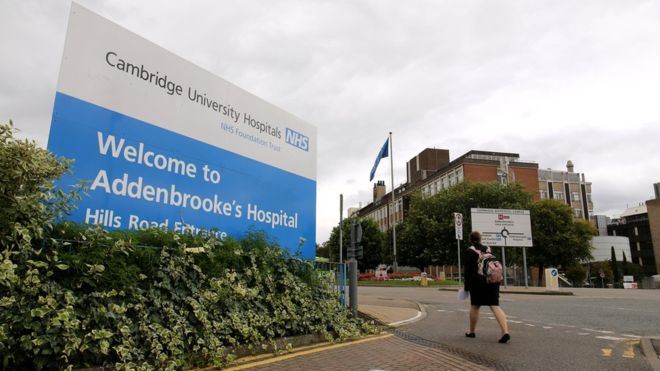
This morning I saw a news story about how the oft-revered Addenbrookes Hospital in Cambridge had been taken into special measures. This is a very large trust and one which when I was a little younger was synonymous with ground breaking, almost miraculous, life-saving medicine. It probably still is.
The analysis will go on for some time. But I was struck by the summary that senior management had ‘lost it’s grip’ on what was happening around the hospital. Problems that emerged were not ‘picked up’ and then acted on. Failings included ineffective ways of ‘moving people through the hospital’. All of this, we are told, is in spite of the fact that staff are very highly skilled and extremely caring.
Like a neurologist who sees sluggish responses in an otherwise articulate and intelligent patient, I find myself wondering what sort of deficiency in the nervous system of this hospital could lead to such a disconnect between the brain, the eyes and the hands?
[Image: BBC News]
Two Lakes

I see two lakes.
They are identical – in every detail.
The shape of the lake emphasises a wide expanse – the way distant slopes frame a turn which could lead on and on. The way trees mask the nearer shores so the whole lake cannot be seen, but its edges may be guessed at.
Before one lake sits the traveller who has sought and found, yet also stumbled upon, this place. They have crossed the wilderness that lies all about it. They see the stillness of the surface, hear the silence. When a breeze ruffles the lake or a bird cries they know that it is the breeze and the bird, not the lake, which bring the passing change.
The traveller may stay as long as they wish. Others may come and go too. One day the hungry and thirsty traveller must move on, in the hope of returning some time.
Before the other lake sits the monarch. They own this lake, having amassed the power and wealth to build it. The finest artists and gardeners, and a hundred thousand labourers, have elegantly captured the expanse and unseen extent of a natural wilderness lake.
Only the monarch or their guests may visit this place. All around, just out of sight, stand the walls of a great palace. Beyond that a fortress. Beyond that a sprawling city.
The monarch is free to sit here until the end of their life. Guards, unseen and ever vigilant, provide protection from those who have been defeated, outwitted or simply robbed in course of the monarch’s rise.
When a breeze ruffles the lake or a bird cries…
.
.
.
.
.
..
.
.
.
.
Represent Me !
I watched the ‘Leaders’ Debate’ last night. Apart from two nationalists, both significantly women and including the almost poetically compelling Leanne Wood, I wasn’t impressed by what I saw. I didn’t expect to be. There’s no point my adding to the online flotsam by ranting on about why. I’m just going to suggest one of the root causes, take a positive attitude to solving it, and then tell you who to vote for!
The underlying pattern last night, the usual selective quoting of facts and quasi-facts along with abstract rhetoric and a concentration on the faults of the other side(s), stems from Party. Individual politicians’ primary purpose is to get elected or re-elected. Political parties’ primary purpose is to get as many members elected as possible or, rather, to have enough elected to form a majority, take control and allocate Ministerial office to their most powerful members.
Working on the principle that you can’t do anything without power, getting elected comes first for them – getting votes by any means. They can get around to ‘doing good’ and ‘being more honest’ or even ‘listening’ once they have won. This is true both of party and of individuals in a party system – mutual permission to behave a certain way and accepted as “politics”, out of habit, by us. [I’m sure there are learned and subtle people who will tell me that the system of permanent parties is a well-evolved and sophisticated solution which delivers less evil, and more stability, than other forms of government or democracy. Even if they are right I’m not worried – I can’t see us overthrowing the model just yet.]
The only solution I can see is to bring back genuine representative democracy at constituency level. That means people voting for the individual (not the party) they believe will best represent the interests of the constituency in which they live. Government, including dealing with all those necessarily national and international issues, then stems from these elected individuals aggregating around policies or leaders in which they believe. Perhaps that’s how parties started – though I’m inclined to believe they derived from existing outside interests – but the party is no longer a necessary piece of infrastructure. There are now sufficient technological and communications means for a crowd of elected representatives to broker and organise a majority, and an allocation of roles, around a set of sufficiently consensus policies and agendas. Is there really a reason why power could not flow upwards and inwards from representatives of the people, rather than downwards from the tyranny of party nomination? I’m not going to tackle the big theory here [I’m sure there are hundreds of people whose day job that is in academic institutions around the country] nor am I going to suggest a detailed mechanism.
But this principal, that politics would be better if elected representatives were loyal and accountable to their constituency electorate rather than to their party, does point to something that you can and should do, right now, for this general election. If enough people were to do this, pledged to do this, the party monoliths would start to at least crumble a bit around the edges – as nervous candidates saw their future riding on genuine local engagement. It involves going to a bit of effort, but it will then demand some corresponding effort from your local candidates. I think politicians rely on us ultimately being too busy, too turned off, or just too lazy, to do this sort of thing.
Here’s the formula:
Get in touch with your local candidates – or at least as many as you can. Don’t limit yourself to big parties or ‘those who have a chance’. [Even their accessibility and responsiveness should be your first clue].
Ask them the following questions:
- If there was a straight simple conflict between the interests of your party and the interests of this constituency, which would you side with? [Insist on a one-word answer, “Party or Place?”]
- What are the priority issues for the majority of people who live in this constituency?
- What hard evidence do you have that these are really their priorities – rather than your projecting a national party agenda onto this constituency?
- What practical steps have you taken, over how long a period, to help local people to identify and express those priorities?
- Parliamentary candidates talk about wanting to have the privilege of serving their community. Outside of your political campaigning (and anything done in the capacity of MP if you are seeking re-election) what have you already done to serve your local community – e.g. voluntary work or something involving sacrificing your own interests?
- If elected how will you make yourself accountable, against those local priorities, over the life of a Parliament?
Share their answers, or the fact that they don’t give you answers, with as many other people as you can. After all, each candidate should only have one set of answers, so it only takes one constituent to ‘get through’ and obtain them…. these can all then be shared and compared between candidates.
The gist of these questions, and the focus of my proposal, is the single overarching question:
How Will You Represent Me?
That is my proposal. You should vote for the person who gives the best account of how they can earn your vote, by making it count, by representing the diverse and complex beliefs and interests of local people, by representing you. DON’T take any old central office flannel – look for hard, simple answers, backed up by evidence of local knowledge and action. Good answers will only come from remarkable people. We need our MPs to be remarkable people – not party footsoldiers.
This is the challenge to all candidates: #representme
If you support this idea.
Ask the questions. Find ways to share the results. Point others to the questions or to this post – and/or post similar suggestions and links of your own in social media, where appropriate using the hashtag #representme
I’m putting a shortened version of the questions into an image. A sort of reverse pledge card……
You want to be properly represented? Fed up with cartoon politics and political marketing? Do something about it. Don’t vote for a ‘protest party‘, vote for a candidate who will plausibly undertake to represent you, and your place. Visibly support, and rally support for, candidates who are prepared to do that on record. It’s a start.


There will be a Dartford Natters meeting this evening at the usual time and place. 7:30pm, Royal Oak, Spital Street, Dartford.
I’m expecting it to be fairly low key – not least because quite a few regulars are likely to be attending the Radio Kent parliamentary hustings at Acacia Hall. Indeed one such regular, Andy Blatchford, will be featuring in the hustings as the Dartford parliamentary candidate for the Green Party.
But I’m hoping some of those people will come along to the Royal Oak after that, for a bit of ‘green room’ [no pun intended Andy], winding down and continuing some of the discussions.
Meanwhile there’s plenty for us to talk about – Lowfield Street/Tesco and the Working Group, the role of a ‘community of communities’ such as Dartford Natters in being able to feed into those deliberations. More generally what Dartford Natters can be useful for – and does that work best monthly, every two months… or some other pattern – and how we should respond to the fact that the Dartford Matters website has currently gone into hibernation. This should help me decide on a future schedule of ‘Natters’ which I can set up and publicise well in advance.
I look forward to seeing you there, and getting your views on Nattering in the rest of 2015.
Nick.
Dartford Natters meet up – 22nd December
We will be meeting on Monday December 22nd at 7:30pm in the Royal Oak, Spital Street, Dartford
UPDATE: This is still on this evening – though we know lots of people will be otherwise engaged. We should talk a little about how to engage with the DBC draft Local Plan, because the next Dartford Natters – 19th January – is less than two weeks before the consultation deadline. Lots of questions – how can we divide the labour of understanding and responding (e.g. as groups or as individuals), does it really make a difference, what should we ask of the Council to make this process accessible, what will the Council find usable and useful? Then… I may dish out the odd mince pie, if the pub doesn’t mind.
Now that the consultation is official you can find the link here. And there are copies in all the Libraries and Town and Parish Council offices across the borough
This is a week later than the usual monthly date because of various meetings and commitments on the 15th. It’s quite close to Christmas, so who knows what sort of turn-out we will get. But maybe lots of people will be in a festive mood by then. I’m going to have a word with the pub and see if, one way or another, we can get mince pies on the agenda.
We do have a bit of serious business first. The Borough Council is going to be consulting on the Dartford Local Plan and Development Policies Document from December 12th to January 30th. This sets the policies against which individual planning applications and other plans are assessed. So commenting on it is probably a more effective way of having some say in what happens locally, than dealing with individual applications as and when they arise. Basically if you have ever grumbled about particular changes in Dartford, then you should at least look at this plan and, ideally, submit some kind of constructive comment.
That said, it’s a big and quite technical document. I have asked the Council where it will be possible to get hold of hard copies, as it’s a bit of a hefty thing to print out yourself from the internet. I haven’t had an informative answer yet. We should also consider whether the Council needs to do more to highlight the key decisions involved in this plan and make them accessible to local people – above and beyond the document itself. That’s something we should discuss at Dartford Natters, and also what scope there is for groups – including the informal Facebook groups – to pool their resources in understanding and assessing the plan.
I will be writing more about this over the next few days and sharing a link to the draft once the consultation becomes official.
But, for now, that’s the agenda for the 22nd – discuss how we can get involved, and get the maximum number of other local people involved, in constructive consultation over this plan. Then enjoy that sitting-in-a-pub-just-before-Christmas feeling and hopefully the odd Christmas comestible.
Hope to see you there!
November’s Dartford Natters meet up.
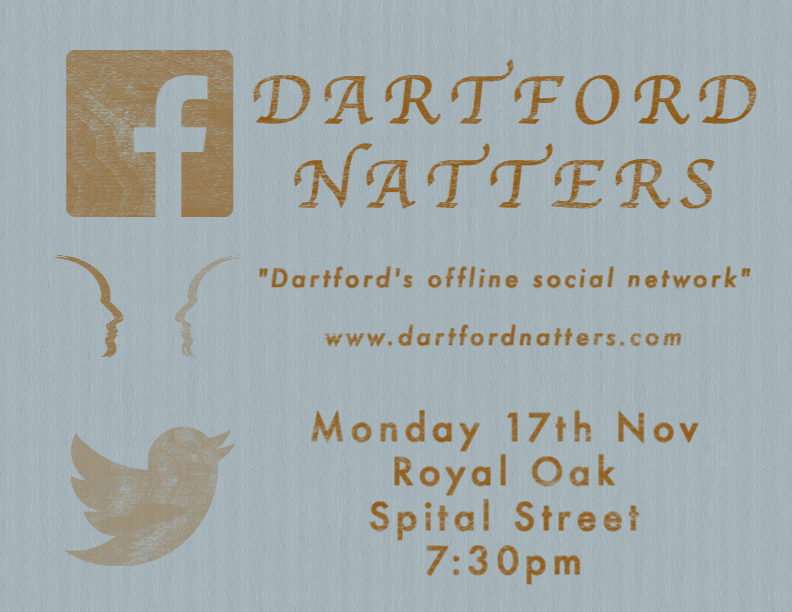
We are meeting again next Monday evening. These Natters seem to come around so quickly. There’s always a resolve to “publicise it more/better next time”. But actually a lot of the people who come regularly will notice the usual tweets and posts.
There’s a page on the Dartford Matters site, which gives background on the monthly Dartford Natters events – and I usually point any reminders at that.
So this post on my own blog is a bit of a stock-take.
The first thing to say is that these events are always fun and relaxed. In spite of periodic misgivings about always meeting in a pub, it doesn’t seem to put many people off. Other venues would feel a bit sterile, and probably cost us money. That said, next summer I will put a bit more planning and prior notice into making at least one Dartford Natters into an afternoon picnic! [All offers of help gratefully received].
Next thing is that we do always get new people – so if you might be a ‘new people’ yourself, don’t worry that you are going to walk in on a clique of people who’ve all known each other forever.
The idea of making this a ‘group of groups’ is also working, as we have had representation from Dartford Big Local, Dartford Arts Network, Litterpickers, Dartford Living, Dartford Hour, Dartford Matters itself, and the Round Table. [Though we have a systematic diary clash with the last of those, that needs some attention]. These people in turn also get to interact with local Councillors who make an admirable effort to turn up even when they have meetings during the same evening. We also have some prospective candidates for next year’s elections.
We have some identifiable representation from Facebook groups – notably Dartford Community Group, though that’s partly down to its strong association with the Round Table.
I always get nice feedback on my posts to other places on Facebook – e.g. from the Dartford Remembered group. But we haven’t had anyone come along from Dartford Remembered, or from Dartford Past Present and Future, and say that this is why they are there – i.e. to connect those FB groups to what’s going on in the offline world. All of which is fine, of course, it just confirms that these are online social media forums – places to talk and share every day of the month – rather than groups for action.
Please leave a comment below if there are other local groups, online or offline, that I should be inviting to come along and connect in this informal setting.
Again, it’s important for me to emphasise that although Dartford Natters is helping to spark, or deepen, connections between local groups, it’s also a gathering for individuals who care about the town.
Above all this is a social event. There will be politics, because that’s what happens when you talk about something you care about. But there isn’t an excess of Politics. Occasionally we may make something happen, but our ambition is just to meet, be welcoming and open-minded, and see what happens.
I hope to see you at a Dartford Natters some time soon.
#dartfordtweetup becomes “Dartford Natters”
 First get-together Monday 15th September, 7:30pm at the Royal Oak, Spital Street Dartford.
About a year ago I was prompted, by nothing more than some overlapping Twitter conversations around Dartford, to suggest a real world get-together. So #dartfordtweetup was born. It didn’t have a set purpose or agenda – my intention was that this would just emerge.
We have met most months since then and ranged from about 10 to 15 participants. Some very important connections were made, and projects started, which wouldn’t otherwise have happened.
But we have often talked amongst ourselves about two things. What is it now for? Why hasn’t it grown? [The second question alternates with whether we want it to grow – just for the sake of it]. We also did a bit of unscientific market research about what people might want or expect from it, and what puts them off.
We are still happy that the purpose of these gatherings might change and evolve in response to the people who choose take part. But here’s a suggestion. There are several different groups in Dartford which either exist on the internet [not least on Facebook] or use the internet to connect and organise people to do things offline. There are some groups that would like to do more in this way. What all of them have in common is Dartford… anything from just living here, to being curious and concerned about what goes on here, to having active plans to influence and grow our community and culture. These include, Dartford Remembered, Dartford Past Present and Future, Dartford Matters, Dartford Living, Dartford Community Group, Dartford Arts Network, Dartford Litter Pickers, Dartford Mens Shed, Dartford Big Local, Dartford Park Run and Dartford Round Table.
The idea of Dartford Natters [working title :0) ] is that it tries to reflect *offline* the way that, for example, the Dartford Matters blog and social media feeds combine news, information and opinion from as many local sources as possible.
We also found that the label “#tweetup” gave a lot of people the impression that the sessions were all and only about Twitter – which a lot of people don’t use, or still find odd and not always pleasant. Quite a lot of other “#tweetups” around the UK are also mainly for businesses. So we want to make it clear that whilst Twitter was the trigger, and the channel we first used to organise meets, we have quickly found ourselves widening the scope.
We would like as many people as possible who are organisers or active participants in those groups to come along on September 15th. The point? Just to connect, share ideas and intentions, meet new people and have an enjoyable evening. We may discover things that we can link online, share or plan together. But that can all come out in the wash.
I’ll be getting updates out via Dartford Matters too, and contacting as many of these groups’ patrons, admins and officers as I can directly.
But we’re still open to anyone and everyone. Hope you can come.


 Nick Buckley : Practically Mindful